





Bank of America data are pointing to a growing imbalance beneath otherwise solid consumer activity in the U.S. economy. Spending data for March suggests households are still actively buying across key categories, reinforcing the view that demand remains resilient. But a closer look at wage growth tells a more uneven story.
The gap between higher-income earners and everyone else has widened to its widest level since 2015, signaling a shift not immediately visible in top-line data. At the same time, rising gasoline prices are adding pressure where budgets are already tight.
Together, these trends highlight a developing divide in how different income groups experience the same economic environment, with implications that extend beyond monthly spending into longer-term financial stability.
Bank of America wage data show the income gap at a record high
Higher-income households saw their after-tax wages and salaries jump 5.6% year over year in March, the fastest growth for that group since August 2021.
However, lower-income households managed just 1% growth over the same period, and middle-income earners landed at 2%, according to the Bank of America Institute’s Consumer Checkpoint report.
That divergence represents the largest wage-growth gap the bank has recorded since its data series began in 2015, the report noted. The acceleration among top earners appears driven in part by larger bonus payouts, while bonuses for lower- and middle-income workers declined.
The consequences show up immediately in spending patterns. Lower-income households increased their total card spending by 2.2% year over year in March, while higher-income households posted a 3.9% gain, the report found. That gap is not simply about preferences or lifestyle choices. It reflects how much room each group has to spend after covering essentials.
Every penny increase in gasoline prices strips roughly $1.5 billion from annual consumer spending, a burden that falls hardest on those with the least financial cushion, Ryan Sweet, chief U.S. economist at Oxford Economics, told CBS News.
How gasoline prices deepen the income divide for lower earners
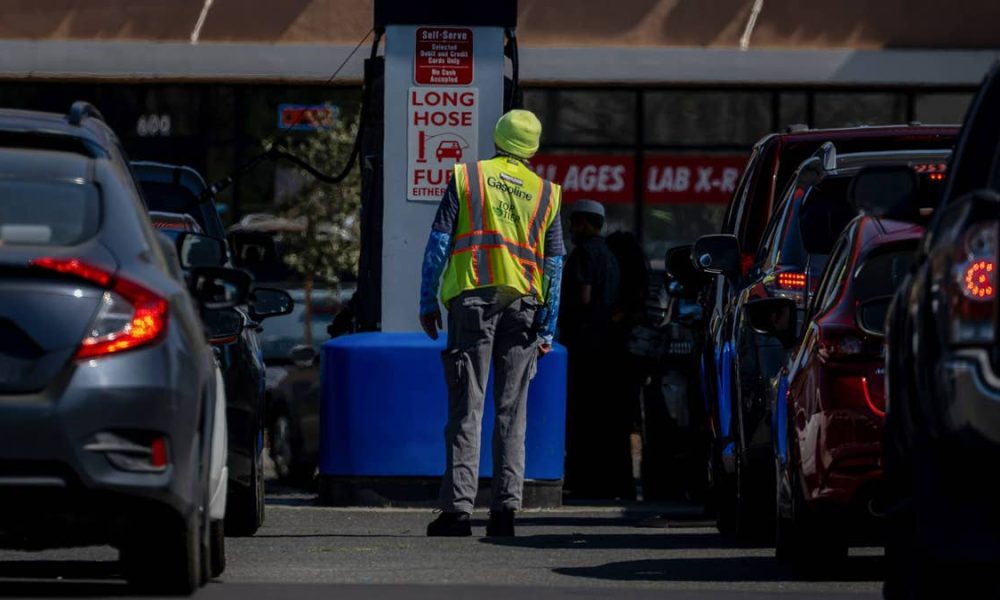
The wage gap alone would be concerning enough, but rising fuel costs are further straining lower-income households. Gasoline spending for this group represented roughly 8% of their total card spending in March, approximately double the share for higher earners, the Bank of America report showed.
National gasoline prices surged from roughly $3 per gallon to around $4 per gallon by the end of March, the report found. That increase pushed household gasoline spending up 16.5% month over month.
Lower-income households pulled back on discretionary purchases last month, and their spending growth on nonessential goods dropped relative to that of middle- and higher-income groups.
Historical patterns also back up this move. During two previous periods of sustained gas price increases, from December 2008 to May 2011 and from February 2016 to October 2018, spending on durable goods and groceries both declined as a share of total household spending, the bank’s analysis found.
When families pay more at the pump, they tend to trade down at the grocery store and delay larger purchases. Rising costs for gasoline and utilities function like a tax on households by cutting into real disposable income, Moody’s analysts wrote in a recent report.
As consumers spend more on essentials, they inevitably pull back elsewhere, the firm warned, according to Fortune.
Moody’s chief economist Mark Zandi has separately described the U.S. economy as “largely powered by the well-to-do,” with only the top 20% of earners spending enough to outpace inflation in recent years, Fortune reported.
Bloomberg/Getty Images
Pandemic-era wage gains for lower earners are being reversed
One of the few bright spots during the pandemic recovery was that lower-income workers saw meaningful pay increases. From 2020 through 2024, the wage gap between lower and higher earners narrowed substantially, according to the Bank of America report.
Tight labor markets, retention bonuses, and minimum wage increases gave lower-paid workers a rare period of relative gains.
“There’s really no way to know whether this is a blip, something that’s temporary, it’ll disappear next year, or whether this is the beginning of a trend,” said University of Missouri Labor Economist Peter Mueser.
The bank tracks the ratio of lower- to higher-income wages, indexed to 2019 levels. After peaking around 2023, that ratio has been sliding back toward its pre-pandemic baseline. Faster pay gains for top earners are chipping away at the ground lower-income households gained during the recovery, the report found.
The overall wage gap is still narrower than it was before the pandemic, but the trend line has shifted decisively in the wrong direction, the bank’s researchers observed. If the current trajectory persists, the remaining gains could erode within the next year.
Tax refunds offer temporary relief but favor higher-income households
Larger tax refunds this filing season have provided a short-term buffer, particularly for discretionary spending and debt repayment. Early filers have directed their refund money toward home improvement, electronics, and clothing rather than necessities or travel, the bank’s payments data indicated.
Lower-income households are using refunds to pay down credit card debt, which could help stabilize their balance sheets in the near term, the report found.
The extra cash from refunds could offset increased gasoline costs for roughly five months for lower-income households, about seven months for middle-income households, and approximately eleven months for higher-income households, the bank estimated.
But even tax season tilts toward the top. Higher-income households are receiving larger refund increases than other groups, the bank’s deposit data confirmed. Lower tax payments resulting from the One Big Beautiful Bill Act may benefit higher-income households more than anyone else, BofA Global Research noted in findings cited in the report.
What the spending data signal for the broader economy
The two-track reality in wages and spending carries real consequences beyond individual households. Consumer spending drives roughly 70% of U.S. GDP, according to CBS News. If lower- and middle-income households continue to retrench while top earners carry the load, the economy becomes increasingly dependent on a narrow base.
Lower-income consumers are clearly coming under pressure, and the longer that dynamic persists, the greater the risk to overall consumer spending, Pooja Sriram, U.S. economist at Barclays, told CNBC. Barclays views the current divergence as a meaningful vulnerability for the economy heading into the second half of the year.
For households managing tighter budgets, the bank’s data offers a concrete snapshot of how costs are shifting. Gasoline, which is unavoidable for most commuters, is absorbing a growing share of spending at the bottom of the income scale. Discretionary categories like dining out and travel remain healthy for upper-income groups but are softening for everyone else.
The overall picture from the bank’s data is not one of broad consumer weakness. Spending remains positive across income groups, and tax refunds are providing a cushion.
But the underlying wage dynamics increasingly favor those who already earn the most, and the costs weighing on lower-income households, from gasoline to groceries, are not going away soon.