




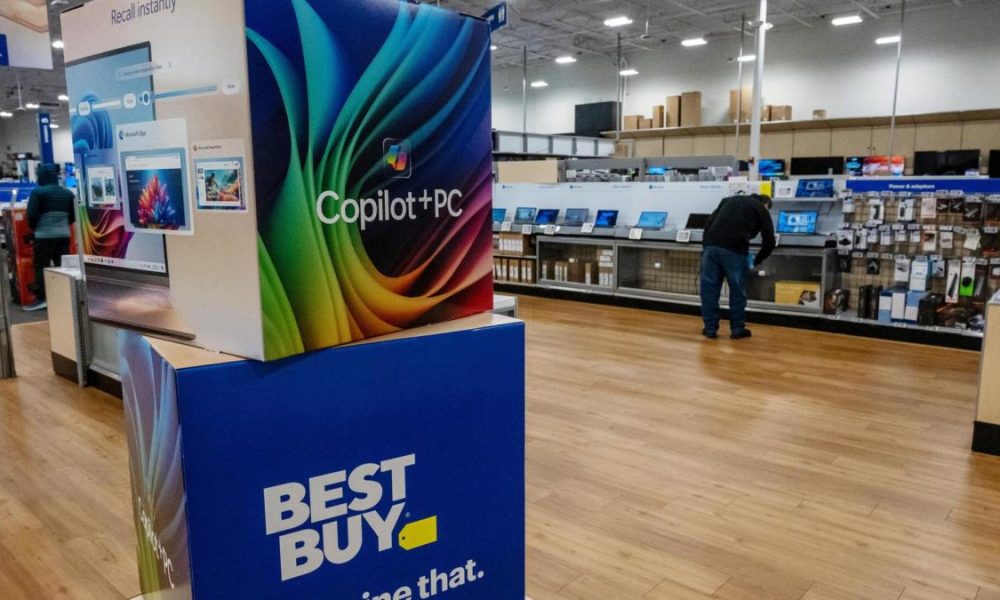

Valued at a market cap of over $14 billion, Best Buy competes head-to-head with Amazon in the consumer electronics and appliances segment. Given a quarterly dividend payout of $0.95 per share, Best Buy (BBY) offers shareholders a tasty dividend yield of 5.6% in 2026.
That’s notable given that Amazon doesn’t pay a dividend, making Best Buy an attractive option for income-focused investors seeking exposure to the tech retail space.
Does Best Buy have a sustainable payout?
While the dividend looks attractive at first glance, let’s see whether the retailer is well-positioned to maintain these payouts.
Getty Images Bloomberg 02062026
According to data from Tikr.com, between fiscal 2026 and fiscal 2030, Best Buy is forecast to increase:
- Revenue from $42.4 billion to $45.83 billion.
- Adjusted earnings per share from $6.71 to $9.05.
- Free cash flow from $1.54 billion to $2.02 billion.
The annual dividend expense for Best Buy is approximately $780 million, indicating a 51% payout ratio in 2026.
Best Buy has enough room to maintain its payout and even raise dividends in line with cash flow growth.
In fact, Best Buy raised its quarterly dividend from $0.70 per share to $0.95 per share in the last five years.
Where Best Buy competes with Amazon
Best Buy and Amazon go head-to-head across multiple fronts in consumer electronics and home appliances.
Amazon’s massive online marketplace offers convenience and competitive pricing, while Best Buy provides expert advice, in-store experiences, and same-day availability.
Notably, Best Buy launched its own third-party marketplace last August, which directly challenges Amazon’s core business model.
In just three months, Best Buy has onboarded over 1,000 sellers and expanded its online catalog by 11 times.
Best Buy CEO Corie Barry noted that marketplace return rates are lower than first-party sales, with 80% of returns occurring in-store, giving Best Buy a convenience advantage over pure online rivals.
Best Buy beats expectations in Q3
In fiscal Q3 of 2026 (ended in October), Best Buy reportedrevenue of $9.7 billion and earnings of $1.40 per share. Analysts forecast revenue of $9.59 billion and earnings of $1.31 per share in Q3.
Best Buy reportedcomparable sales growth of 2.7%, its strongest performance in four years. Barry pointed to robust demand across computing, gaming, and mobile phones as key drivers.
The retailer saw its seventh consecutive quarter of positive comparable sales in computing, fueled by customers replacing aging devices and upgrading to Windows 11 after Microsoft ended support for Windows 10 in mid-October.
The gaming segment was another key driver in Q3, tied to strong demand for the Nintendo Switch 2, handheld gaming devices, and augmented reality glasses.
Mobile phone sales also accelerated, due to expanded carrier partnerships and improved in-store operations.
Barry stated:
New profit streams taking shape
Best Buy is expanding revenue streams beyond traditional retail.
- Its advertising business, Best Buy Ads, is gaining traction with both endemic and non-endemic advertisers.
- The company recently launched self-serve advertising tools and expanded into demand-side platforms, attracting new categories such as financial services, quick-service restaurants, and sports entertainment.
- The retailer continues to invest in immersive in-store experiences. More than 50 locations now feature Meta AI glasses showcase areas with dedicated experts, and demand for demos is outpacing available appointments.
- Best Buy has partnered with brands like Breville, SharkNinja, and IKEA to create shop-in-shop experiences that drive traffic and sales.
Challenges remain in key categories
However, Best Buy continues to struggle in appliances, which CFO Matt Bilunas called “probably the most difficult” category the company faces right now.
With housing turnover sluggish, most appliance purchases are single-unit replacements of broken items rather than the premium multi-unit sales Best Buy historically captured.
TV sales also remain under pressure, though unit growth turned slightly positive in Q3. Best Buy is addressing these issues by implementing sharper pricing, increased marketing, expanded specialty labor, and improved delivery and installation services.
Holiday outlook stays cautious
Despite the strong third quarter, Best Buy offered a measured forecast for the holiday period.
The company expects fourth-quarter comparable sales to be between down 1% and up 1%, reflecting tougher year-over-year comparisons and potentially slower trends in gaming and wearables.
“The holiday is never easy to predict,” Bilunas acknowledged on the earnings call.
Still, Best Buy raised its full-year outlook. The company now expects revenue between $41.65 billion and $41.95 billion, up from its previous range. Adjusted earnings per share guidance increased to $6.25 to $6.35.
The bottom line
For investors seeking dividend income in the retail sector, Best Buy’s 5.6% yield offers a compelling alternative to Amazon’s growth-focused, no-dividend approach.
While the dividend payout appears sustainable, BBY stock is unlikely to deliver market-beating returns to long-term investors.
Given consensus price targets, Best Buy stock trades at a 17% discount in February 2026. If we adjust for dividends, cumulative returns could be over 22%.