




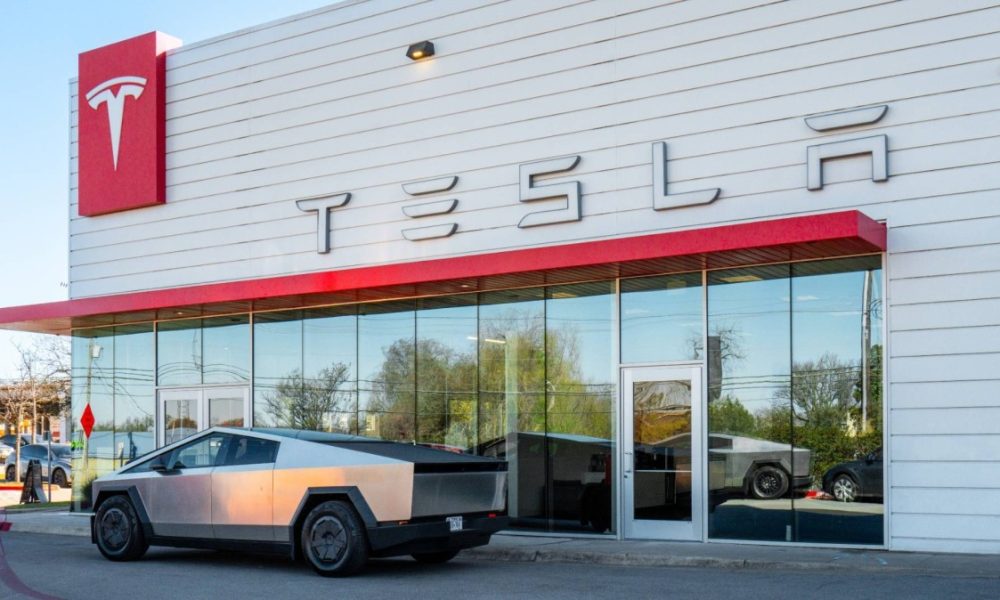

Tesla Inc. (TSLA) has been one of the market’s most volatile and closely watched names over the past year.
Incorporated in July 2003, the American multinational automotive company headquartered in Austin, Texas, has delivered strong long-term gains. What has helped it?
It’s optimism around artificial intelligence, robotaxis, and autonomous driving. But beneath the surface, cracks are starting to form. A new warning from one major Wall Street bank is sounding the alarm and raising a more serious question.
Could the stock be heading for a much deeper drop?
Shares are trading around $362 as of this writing, and are already down 19% year-to-date as per Yahoo Finance. Yet even after that pullback, HSBC believes the decline may not be over.
In fact, the bank’s lead analyst sees a scenario in which Tesla stock could fall by more than 60%. As much as 65%. So what’s driving that bold call? And again, should you be worried if you have Tesla in your portfolio?
HSBC warns Tesla stock could drop to $131
HSBC analyst Michael Tyndall has reiterated a “reduce” rating on Tesla, with a $131 price target. Yes, you read it right. That’s far below current levels.
That implies a potential drop of roughly 63% from where the stock is recently trading.
The reasoning? It comes down to valuation pressure and slowing momentum in Tesla’s core business.
While bullish investors have focused on future opportunities like robotaxis and humanoid robotics, HSBC argues the core electric vehicle (EV) segment still matters most. And that’s where cracks are starting to show.
Vehicle deliveries declined in 2025, while overall revenue slipped about 3% year-over-year. Production also decreased 5.5% year over year.
If that trend continues, it could weigh heavily on the stock.
So the big question becomes. Can Tesla’s future bets outweigh weakness in its main business?
Tesla’s EV business faces global pressure and rising competition
Tesla’s challenges aren’t happening in a vacuum. The global EV market is shifting. And the shift is not necessarily in Tesla’s favor.
HSBC notes that EV demand is becoming more regionalized, with consumers in markets like China and Europe increasingly favoring local brands.
That shift is already showing up in the numbers.
- China-based rival BYD has surpassed Tesla in annual EV sales
- Tesla delivered about 1.64 million vehicles in 2025, trailing BYD’s 2.26 million
- European sales have weakened sharply in key markets
Tesla has also not launched a new vehicle since the Cybertruck in 2023
The company hasn’t launched a new mass-market vehicle since the Cybertruck in 2023. Instead, it has focused on refreshing existing models and building out future technologies.
Meanwhile, competition is heating up. That’s especially from lower-cost, high-tech EV makers.
There are also policy headwinds. The expiration of key U.S. EV tax credits has changed the economics of buying electric vehicles, leading to softer demand across the industry.
Looking at sales, Tesla’s sales have plummeted in Europe amid backlash over CEO Musk’s endorsement of the far-right German party AfD. As per Reuters, December registrations dropped 66% year-over-year in France and 44% in Spain.
Is Tesla really still a growth story or entering a more mature phase?
Tesla’s long-term growth bets keep investors divided
Despite the near-term concerns, Tesla’s long-term story remains intact. At least for some investors.
The company is pushing aggressively into areas like:
- Autonomous driving and robotaxis
- Artificial intelligence and robotics (Optimus)
- Energy storage and grid-scale solutions
These initiatives are a big reason why Tesla still commands a premium valuation.
But HSBC argues that relying too heavily on future opportunities without stronger execution in the core EV business could be risky.
Tesla sales also fell for the second year in a row
Its recent financial performance highlights that tension. Tesla released its latest quarterly sales figures, and they were worse than Wall Street expected.
Key Q4 2025 metrics included;
- Revenue: $24.9 billion (down 3% year-over-year)
- Deliveries: 418,227 vehicles (down 15.6%)
- Production: 434,358 vehicles (down 5.5%)
As per CNBC, Wall Street expected 426,000 deliveries for the quarter. Those annual sales declined for the second consecutive year. And that’s where the Chinese rival BYD surpassed Tesla for the first time in annual sales of battery-electric vehicles.
There were bright spots, though.
- Energy storage deployments hit a record 14.2 GWh
- Energy revenue grew 26.6% year-over-year
So, what should you watch next for in Tesla?
Looking ahead, Tesla’s trajectory will likely depend on a few critical factors:
- Whether vehicle demand stabilizes in key markets
- Progress on new products and autonomous technology
- Competitive pressure from global EV rivals
- Margin recovery as pricing and costs evolve
Well, looking at it, HSBC’s call may seem extreme. But it points to a growing concern that warrants further assessment.