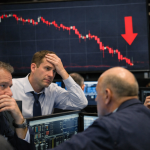






“Reasons to worry.”
That is Wells Fargo CEO Charles Scharf’s curt, three-word take on the U.S. economy, despite reiterating the strength of the current macro backdrop.
Consumers are still spending, employment numbers remain relatively strong, and wages are growing, meaning businesses are still in good shape, Scharf argued in a pertinent interview on Fox Business’ “Mornings with Maria.”
However, he also warned that the markets are showing “fragility or a nervousness” that hasn’t quite spilled over into the economy.
That tension was at the core of Scharf’s message.
On the one hand, he laid out the case that Wells Fargo is seeing robust credit quality and steady consumer borrowing amid a resilient economic backdrop.
On the flip side, he feels that investors and company management continue to ignore the evolving list of risks quietly building beneath the surface.
Front and center are the impacts of the Iran conflict on global markets and oil prices, along with growing uncertainty around borrowing and investment.
For context, since the Iran war began on Feb. 28, Reuters reported, Brent crude oil and WTIare up nearly 60%, while average U.S. gasoline prices surged 36% in March alone.
Also, U.S. gas prices have shot up above $4 a gallon for the first time since 2022.
Additionally, investors are increasingly taking a “show-me” attitude toward the AI trade, especially as capital expenditures continue to balloon.
So even if the U.S. economy still looks solid on the surface, it’s imperative not to turn a blind eye to the warning signs flashing underneath.
Michael M. Santiago on Getty Images
What the latest U.S. economic data say
The latest U.S. economic data still point to resilience, though growth numbers are sluggish, inflation levels remain sticky, and activity remains uneven beneath the surface.
- Jobs: The latest official BLS print showed February payrolls down by 92,000, with unemployment at 4.4% (a remarkably weak report, with clear signs that hiring levels have cooled).
- Inflation: February CPI rose 2.4% year over year and 0.3% month over month, in line with forecasts; core CPI held at 2.5%.
- Consumer spending:February retail salesclimbed 0.6%, topping forecasts of 0.5%, per Reuters; core sales rose 0.5%, underscoring that consumers are still holding up.
- GDP:Fourth-quarter growth was revised to 0.7% from 1.4%, Reuters noted, a downside miss that points to a steep late-2025 sluggishness in demand.
- Manufacturing/services:ISM manufacturingPMI hit 52.7 in March, up again, according to ISM. Services stood at 56.1 in February, so both remain in an expansionary phase.
Why Wells Fargo’s Charles Scharf still sees a strong economy
For all the nervousness around the Iran war, oil, and market volatility, Scharf still feels the economy held up a lot better than many investors would expect. He argued that the real economy and the market mood are telling different stories at this point.
“The economy is still extremely strong,” Scharf said.
“When we look at it, consumers are still spending, even with increases in oil prices, they’re spending, you know, 20-30 percent more on oil, but they haven’t stopped spending on everything else,” he added. “Delinquencies are still strong, employment is strong, wages are still growing, and businesses are in good shape.”
That is the core of Scharf’s view: The risks to the economy aren’t imaginary by any stretch of the imagination, but the core data suggest that Wells Fargo’s customer base still looks resilient.
Consumers are borrowing at virtually the same rate, while credit quality remains as robust as ever, and the broader health of both households and businesses hasn’t yet broken down.
The 4 risks Charles Scharf says investors should watch
Though the economy is still holding up, Scharf pointed to multiple fault lines investors can’t ignore.
Here are four of the major risks he identified that could become serious if market stress spreads.
- War-driven market weakness: Scharf said markets are showing fragility, even though it hasn’t yet shown up in the numbers.
- Higher oil prices: He said that a prolonged war and additional spikes in oil could eventually impact spending and confidence much harder.
- Business hesitation: Scharf argued that companies are becoming much more cautious about borrowing, investing, and building inventories amid current uncertainty.
According to the ISM, the Inventories Index tanked to 47.1 in March, and none of the six big sectors grew inventories, highlighting that companies are keeping stock lean. - Credit risk in hot markets: He flagged data-center lending and private credit as major areas of concern, making it critical to separate the wheat from the chaff.
For some color, private credit accounts for nearly 30% of the U.S. leveraged-finance market, Reuters notes, up substantially from the 13% mark a decade ago. Also, Morgan Stanley forecasts annual defaults to hit 8% between the second half of 2026 and the first half of next year.
What it means for investors
For investors, it becomes doubly important to stay alert to sectors sensitive to growing uncertainty, particularly banks, credit markets, energy, and stocks tied to economic cycles.
Though the economy is still mostly strong, Scharf argues that markets are acting more skittish than the underlying data suggest.
There’s a clear risk that hesitation spreads.
If businesses continue to delay investments, trim inventories, and pull back on borrowing, market anxiety will become a major economic problem.
For market watchers, it’s imperative to track the key pressure points to determine whether we’re witnessing a temporary market scare or something bigger.
Growth and inflation forecasts are starting to shift
- Federal Reserve: The Fed recently bumped its 2026 GDP median to 2.4% from 2.3% in December, while also raising its 2026 PCE inflation to 2.7% from 2.4%.
- Atlanta Fed GDPNow: The real-time Q1 GDP estimate was cut to 1.6% on April 2, down from 3.0% on Feb. 27, a sharp cool-off in the growth nowcast.
- OECD: Its March interim outlook forecasts U.S. 2026 headline inflation at 4.2%, up 1.2 percentage points from December, with U.S. GDP at 2.0% in 2026 and 1.7% in 2027.
- Bank of America: BofA estimates PCE might approach 4% this quarter, per MarketWatch, and sees the end-2027 price level 0.5% higher than its previous forecast.